intEMT®

intelligtent Energy Management Toolbox

intEMT® is a modular and flexible software-toolbox for intelligent energy management designed to model, simulate and optimize complex energy systems. Its five core libraries can be used standalone or in combination, enabling tailored solutions from component-level modelling to full-scale intelligent energy management.


Learn more about intelligent energy management with intEMT® on our overview page. Are you interested in the structure and function of our libraries? Then visit our modules page.

Examples of applications can be found under use cases. The development team is introduced on the team page. A few projects in which intEMT® is being developed and/or has been used are described on the projects page. This site also lists several publications related to intEMT®.

Ready to unlock your system’s full potential? Let’s connect!

Use our contact form to get in touch with the intEMT® team.

Advantages

With the help of IntEMT®, we provide our partners many benefits and offers. This enables us to provide support for numerous tasks related to energy management.

© Christopher Lange / Fraunhofer IISB
Advantages for our partners resulting from the use of intEMT.

The possible applications of intEMT® are very diverse and include the following options, among others:

  • Digital twin development We design an accurate model of your energy system based on your components and data. The general flexible modelling approach allows easy adaption to new use-cases and technologies.
  • Intelligent energy management strategies We optimize your energy flows and consider demand-side management to reduce costs and emissions and make the best possible use of renewable energies.
  • Scenario-based system investigation We non-invasively calculate supply scenarios for your energy demands and compare different supply strategies and component constellations.
  • Optimal component sizing We identify economically and technically optimized dimensioning of energy storages, generation plants and grid assets.
  • Tailored operational strategies We develop and validate advanced operational strategies for your energy system non-invasively without intervention in the real system.
  • Software tools You are looking for a specialized software tool based on intEMT that helps you speed up your tasks and processes? We develop a customized solution for you.

Objectives and applications

Thanks to the flexible modeling approach, the possible applications are almost unlimited and new ones can be easily integrated.

© Christopher Lange / Fraunhofer IISB
Overview of some typical use cases that can be realized with intEMT.

Typical applications that are implemented in the intEMT® libraries:

  • Peak shaving with electrical and thermal components, enables savings in grid fees, smaller grid components (such as transformers)
  • Self-sufficiency and local-consumption optimization with renewable energy sources (e.g., PV plant, wind turbines) and storages
  • Day-ahead optimization (purchase and selling of energy on a 15 minutes or 1 hour basis) with energy storages and systems
  • Charging stations management for battery electric vehicles (BEV) or fuel cell electric vehicles (FCEV)
  • Microgrid energy management and isolated networks (stationary and mobile), e.g., for industrial and manufacturing sites, district supply, hybrid ships, vessels and aircrafts etc.
  • Combination of different use-cases (multi-objective)

The intEMT® library is used to optimize energy systems across a wide range of overarching objectives, including but not limited to:

© Fraunhofer IISB
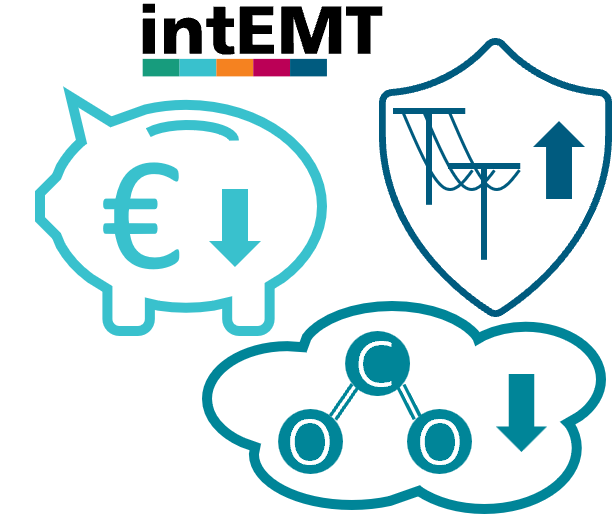
Primary optimization goals achieved by intEMT: cost savings, reduction of emissions, and increased reliability of supply.
  • Cost savings achieved through intelligent energy management methods and operational strategies as well as optimal component sizing
  • Emission reduction achieved through the optimal use of locally available renewable energy sources (RES) like photovoltaic (PV), solar thermal plants, wind turbines etc.
  • Resilient energy supply achieved through robust operating strategies, consideration of redundancies, intelligent retention of capacity in storage and evaluation of possible fault cases