Modules

Overview

The five core libraries shown in the table enable the development and implementation of energy management and operational strategies as well as component dimensioning and scenario-based energy studies.

Software library modules

Module Description Main features
Component models Generalized modelling approach for the energy technology components covering numerous use cases
  • Includes simulation and optimization methods
  • Types: converter, external data, external supply, source, storage
  • Examples: battery, thermal energy storage, fuel cell, combined heat and power plant (CHP), heat pump etc.
Operational strategies Operational strategies for plants with or without storages, can also be used stand-alone
  • Monitors and controls operation constraints like minimum operation time or state of charge limits
  • Interface to higher-level energy management
Systems Energy systems where components are connected with grids
  • Generate, configure and handle energy systems which consist of blocks of the component library
  • Manages simulation and optimization of comprehensive energy systems
  • Additinal features like logging and evaluation
Dimensioning Sizing of energy storages and plants for various applications
  • Integrates components and operational strategies
  • Used for peak shaving, local consumption optimization and other
Energy Management Economic Model Predictive Control (eMPC) based energy management
  • Integrates all other libraries
  • Real-world application of the strategies

Component library

Simulation and optimization models for components

© Christopher Lange / Fraunhofer IISB
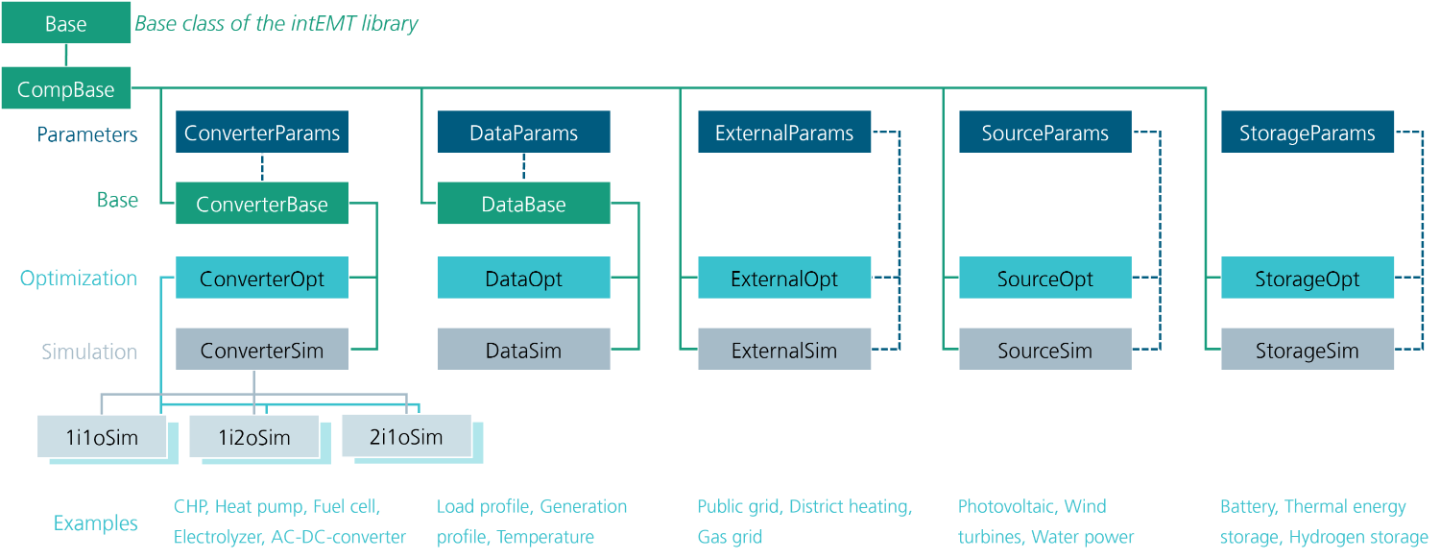
Structure of the intEMT component library, which contains simulation and optimization functions.

The component library includes simulation and optimization models for all relevant component types.

Features:

  • Modelling principles: Dynamic, discrete, and deterministic models (simulation) and LP/MILP (optimization)
  • Advantage over other libs: Flexible and generalized modelling approach allows easy adaption to new technologies and applications
  • Main components
    • Converter: energy conversion (different IO-configurations)
      Examples: combined heat and power plant (CHP), fuel cell, heat pump, power electronic converter
    • Data: datasets
      Examples: load profile, generation profile
    • External: power import and/or export
      Examples: grid connection like public electricity grid and district heating
    • Source: energy source
      Examples: photovoltaic, wind turbine
    • Storage: energy storage system
      Examples: battery energy storage system, thermal energy storage (heating, cooling), hydrogen storage

Operational strategy library

Monitor and control plants and storage systems

© Christopher Lange / Fraunhofer IISB
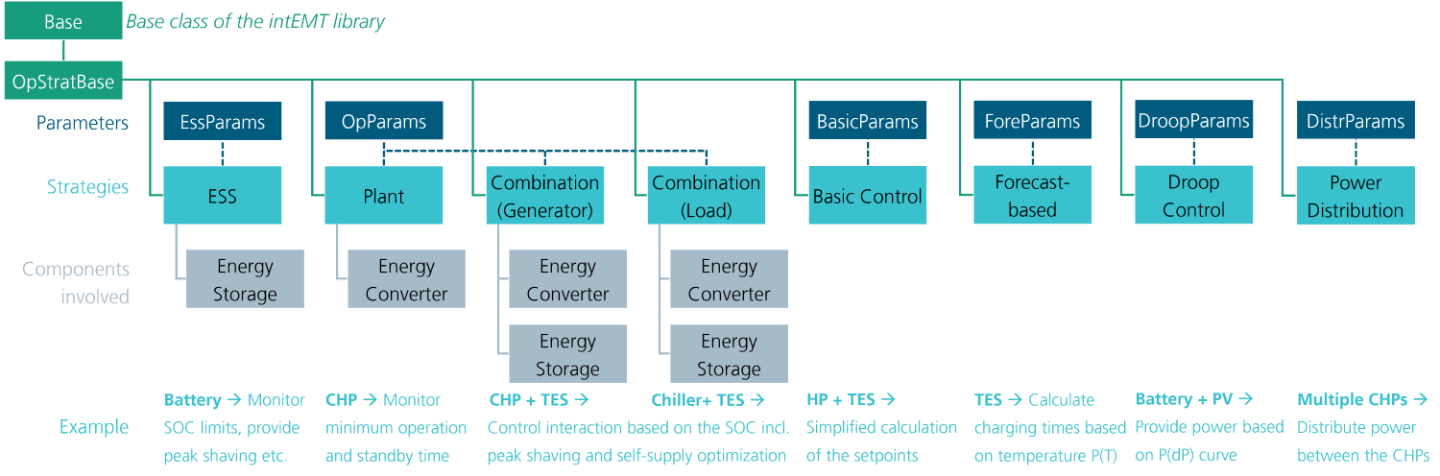
Structure of the intEMT operational strategy library, which contains several algorithms and control functions.

The local operational strategies are used to monitor and control plants and energy storage systems. Thus, on the one hand, they represent independent operating strategies, and on the other hand, they are used as an interface to the energy management system.

Features:

  • Modelling principles: Deterministic finite state machines and mathematical equations
  • Tasks
    • Basic real-time operating strategies
    • Monitoring of boundary conditions  such as minimum operating and standby times, SOC limits, etc.
    • Interaction between component and EMS → local operating strategy takes EMS commands into account
  • Applications: Energy converters and/or energy storage systems (e.g., CHP with heat storage)

System library

Define energy systems with elements from component lib

© Christopher Lange / Fraunhofer IISB
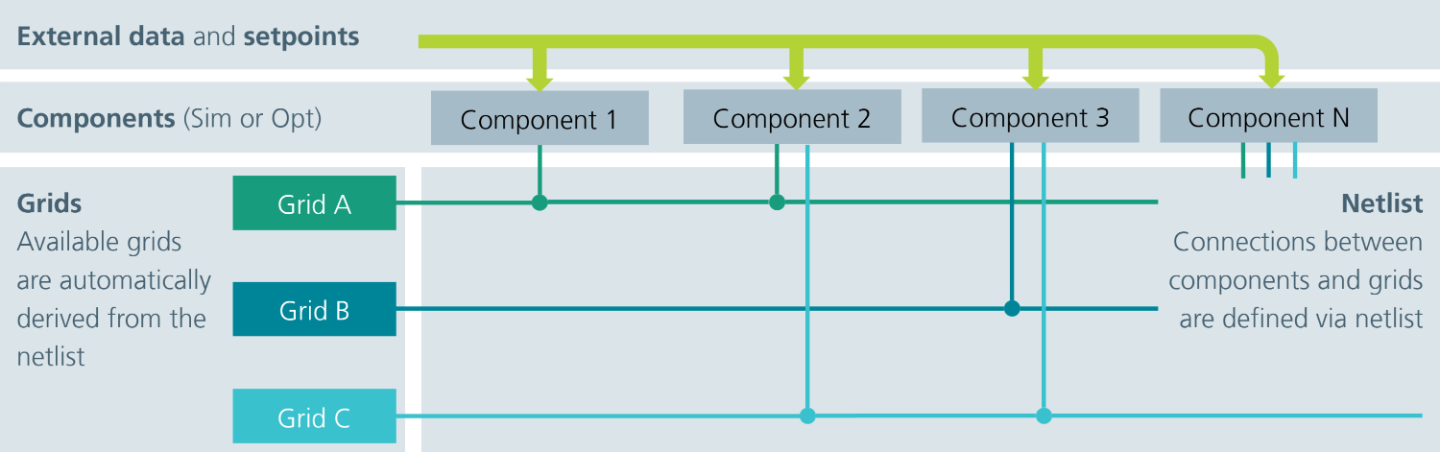
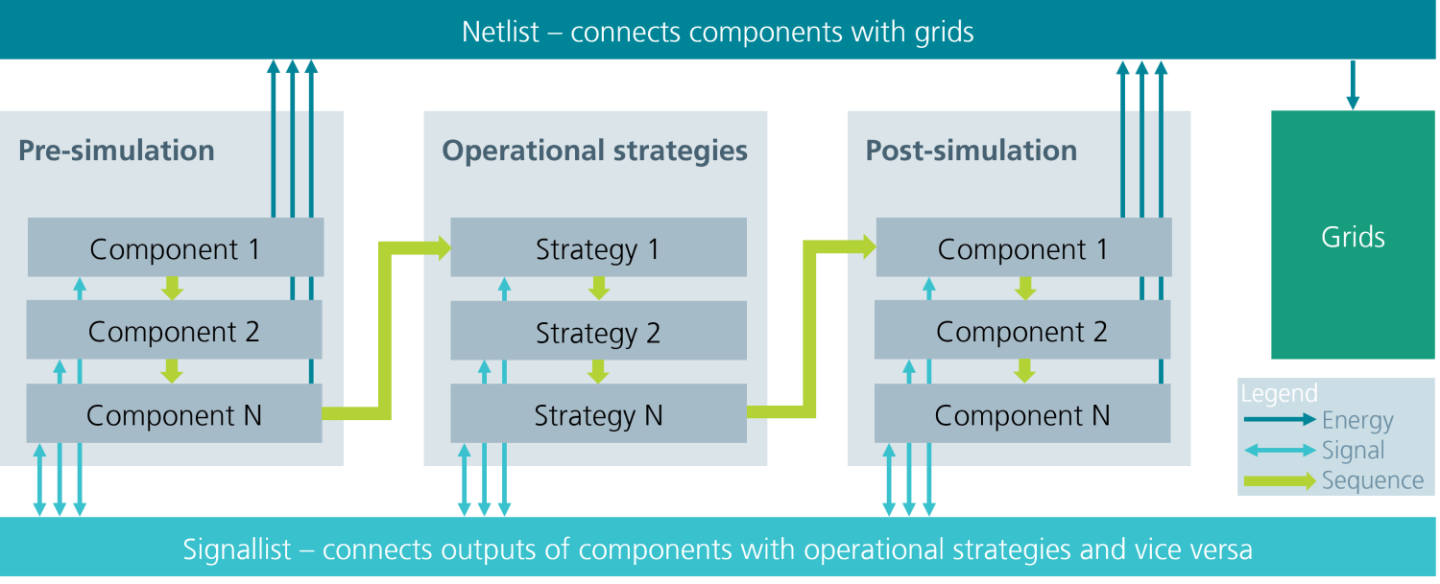
Schematic representation of the system class, in which the inputs and outputs of components are connected via a netlist with networks.
Energy systems are built and managed with the help of system classes. A system consists of elements from the component library and connects the components with grids.
Features:
  • Manages simulation and optimization of comprehensive energy systems
  • Tasks
    • Connection of components, grids, data, and setpoints
    • Methods for logging, evaluation etc.
  • Job list for execute multiple simulation or optimization runs, e.g., for use in parameter studies and scenario-based investigations

The job list is used to perform multiple simulation and optimization runs. Parameter changes (e.g., different storage capacities or varying peak power of a PV system) can be specified for each run. The module supports multiprocessing, which enables fast processing and excellent utilization of the computer.

Dimensioning library

Sizing of energy storages and plants

© Christopher Lange / Fraunhofer IISB
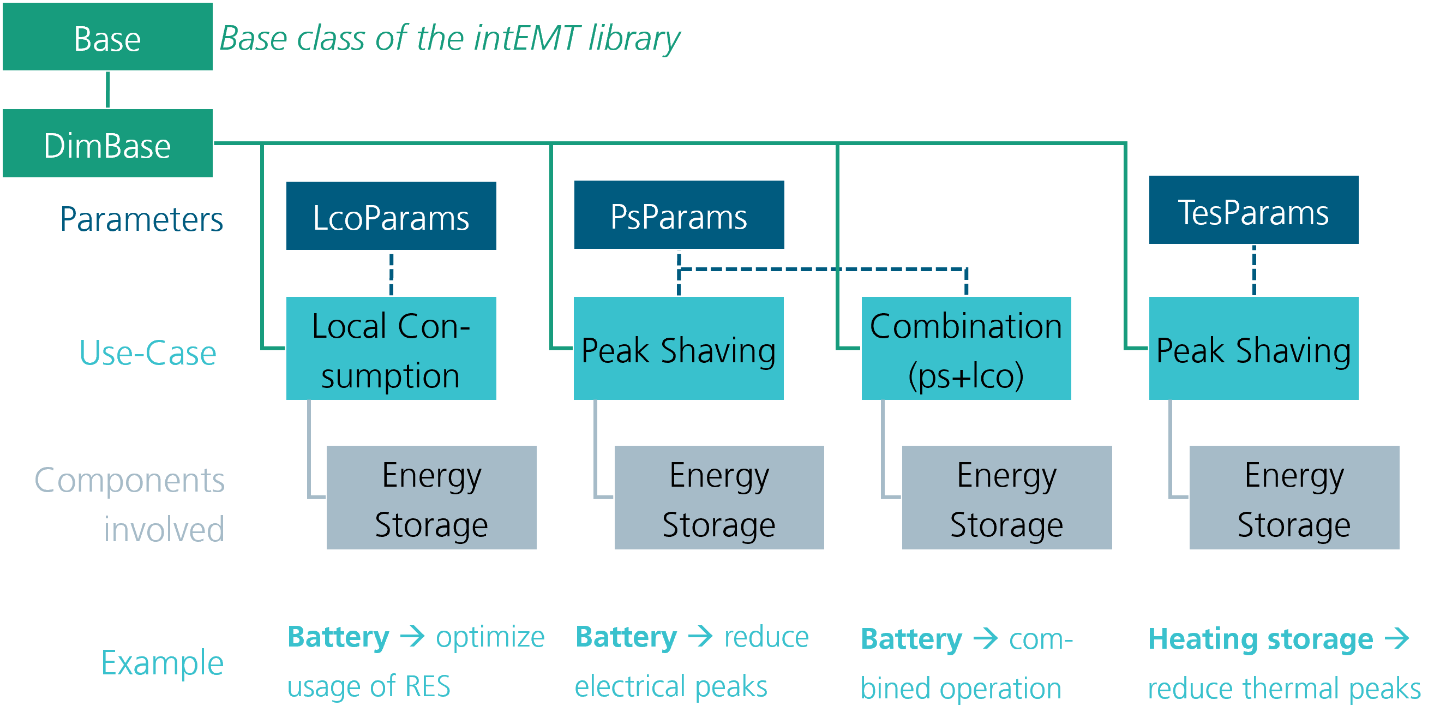
Structure of the intEMT dimensioning library, which is used to optimize parameters of energy storages and plants for different use-cases.
The dimensioning library contains methods for different use-cases. The goal is to achieve an optimal and neutral (i.e., manufacturer-independent) design of energy system components.
Features:
  • Modelling principles: MILP and Greedy-based
  • Applications
    • Peak shaving, peak load reduction
    • Self-supply optimization
    • Local consumption optimization
    • Combinations of several use-cases
  • Uses component and operational strategy libs

The module supports multiprocessing, which enables excellent utilization of the computer.

Energy management library

Intelligent energy management strategies to optimize complex energy systems

© Christopher Lange / Fraunhofer IISB
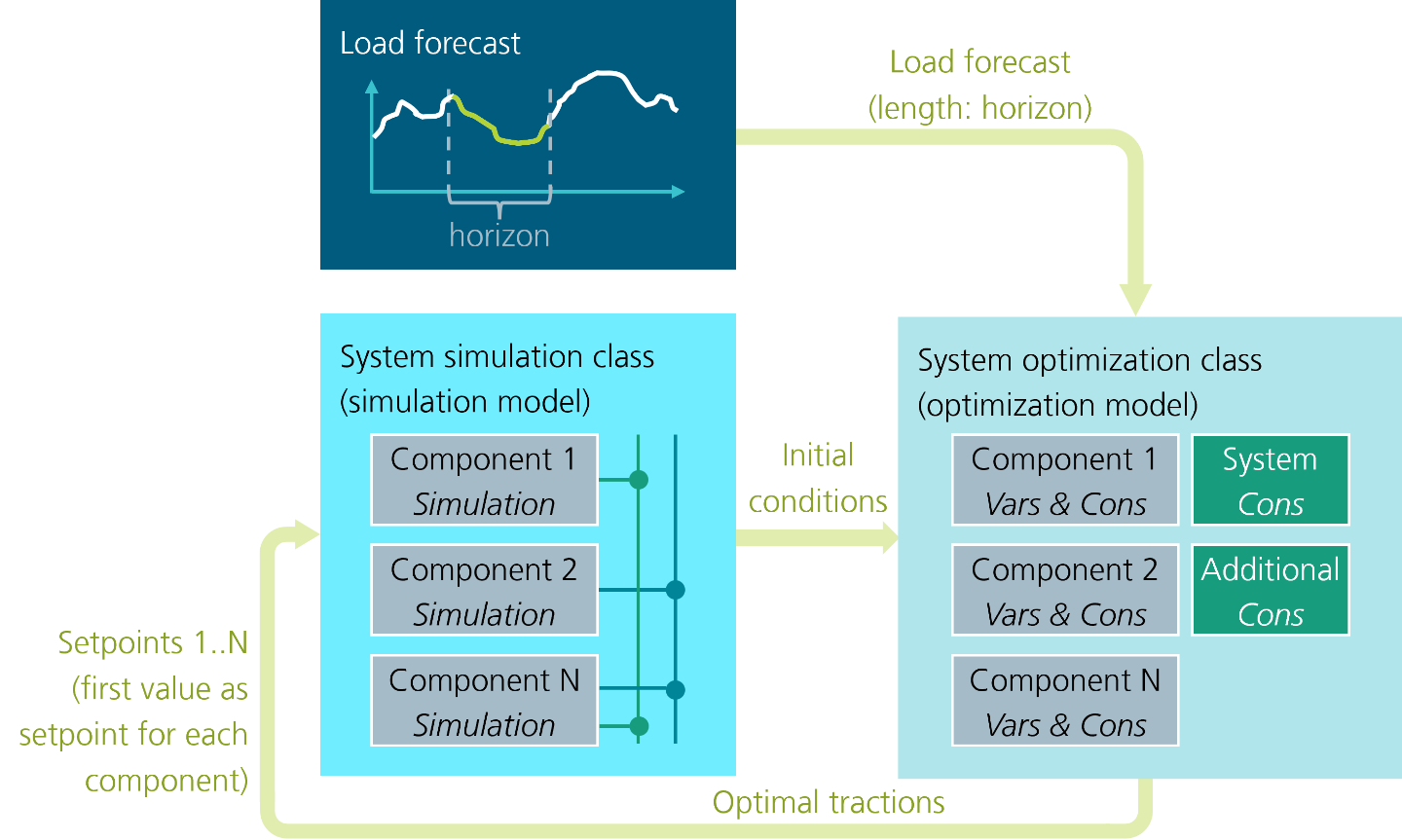
Economic Model Predictive Control (eMPC) approach for energy management applications with the intEMT strategies.
Features:
  • Modelling principles: predominantly MILP
  • Objective functions
    • Energy costs (purchase and feed-in tariffs, day-ahead)
    • Emissions
    • Plant-specific objectives like operation time maximation
    • Any combination of the other objectives
  • Uses component and system lib

eMPC:

The implementation for theoretical and real-world applications is carried out with with an economic model predictive control (eMPC) approach:

  1. Calculation of the load prognosis (currently not part of the library)
  2. Pass a part (length is horizon) of the load forecast to the optimization model
  3. Calculation of the optimization model → Optimal time profiles for the target values of the components, considers
    • Components (variables and constraints)
    • System (network balance equations)
    • Additional constraints (e.g., maximum number of cycles of a storage unit)
  4. Pass the first result time step to the simulation model as component setpoints (in a real-world application, the control units of the plants receive the setpoints)
  5. Calculation of the simulation model → Outputs (e.g., state of charge of a storage unit) are initial conditions for the next run (in a real-world application, the measured values from the plant controls are used)